
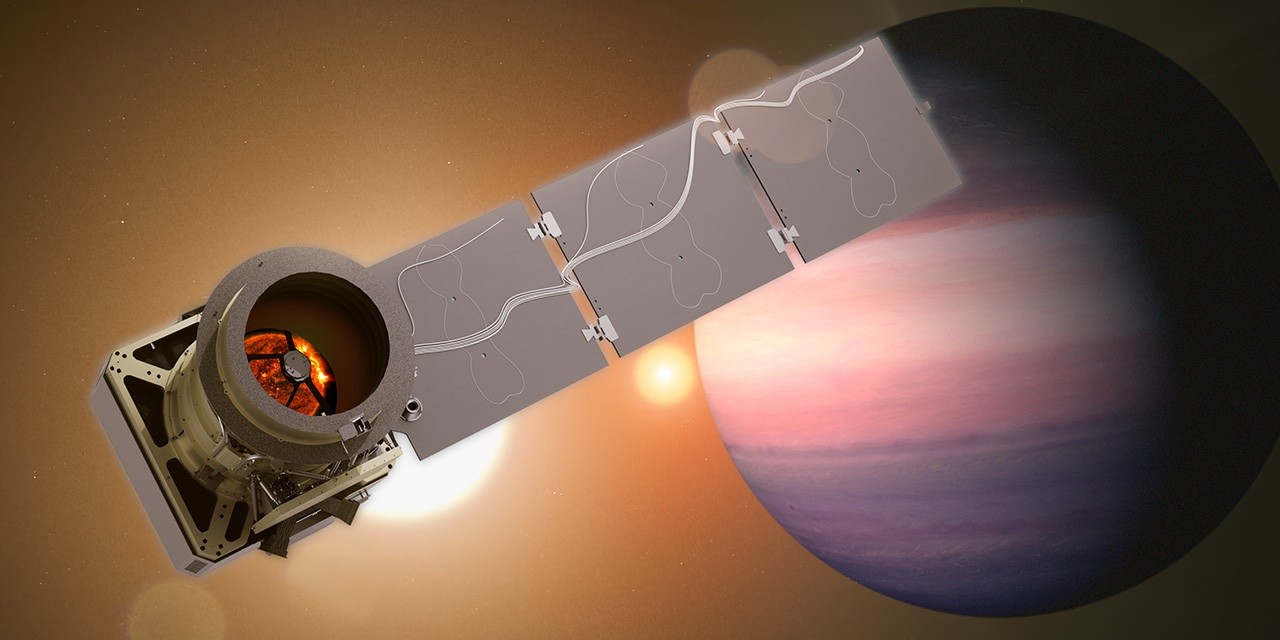
A small telescope with a patient job
A planet passing in front of its star leaves a faint chemical signal in the starlight that reaches a telescope. The star is not a perfectly uniform lamp, though. Hotter and cooler regions on its surface can distort the same measurements scientists use to study an exoplanet’s atmosphere.
NASA’s Pandora satellite has now completed commissioning and begun science observations aimed at separating those two signals. The mission will watch at least 20 exoplanets and their host stars in visible and near-infrared light during its planned year of primary operations.
Pandora is not searching for a declaration that life exists elsewhere. Its more immediate work is methodological: helping researchers tell which parts of a spectrum belong to a planet’s atmosphere and which may come from activity on the star.
Why longer observations matter
The spacecraft is designed to revisit each target repeatedly and stare for long periods, including the hours before, during, and after a transit. NASA says that pattern will give researchers a better record of how the host star changes while the planet crosses in front of it.
That information can complement data from the James Webb Space Telescope. Webb is far more capable, but demand for its time is intense. Pandora’s narrower mission can spend longer on the stellar context that helps scientists interpret a precious Webb observation.
The mission page also shows the boundary between readiness and result. Pandora has begun gathering science data; it has not completed the observing program or published a final atmospheric catalog. Instrument health and a successful start are meaningful milestones, not substitutes for the analysis ahead.
A public record that can grow
Pandora’s science data is intended for NASA’s Exoplanet Archive, giving other researchers a route to examine and reuse the observations. The hopeful news is precise: a relatively small U.S. mission has moved from preparation into real science, with a job that could make larger discoveries easier to trust.