
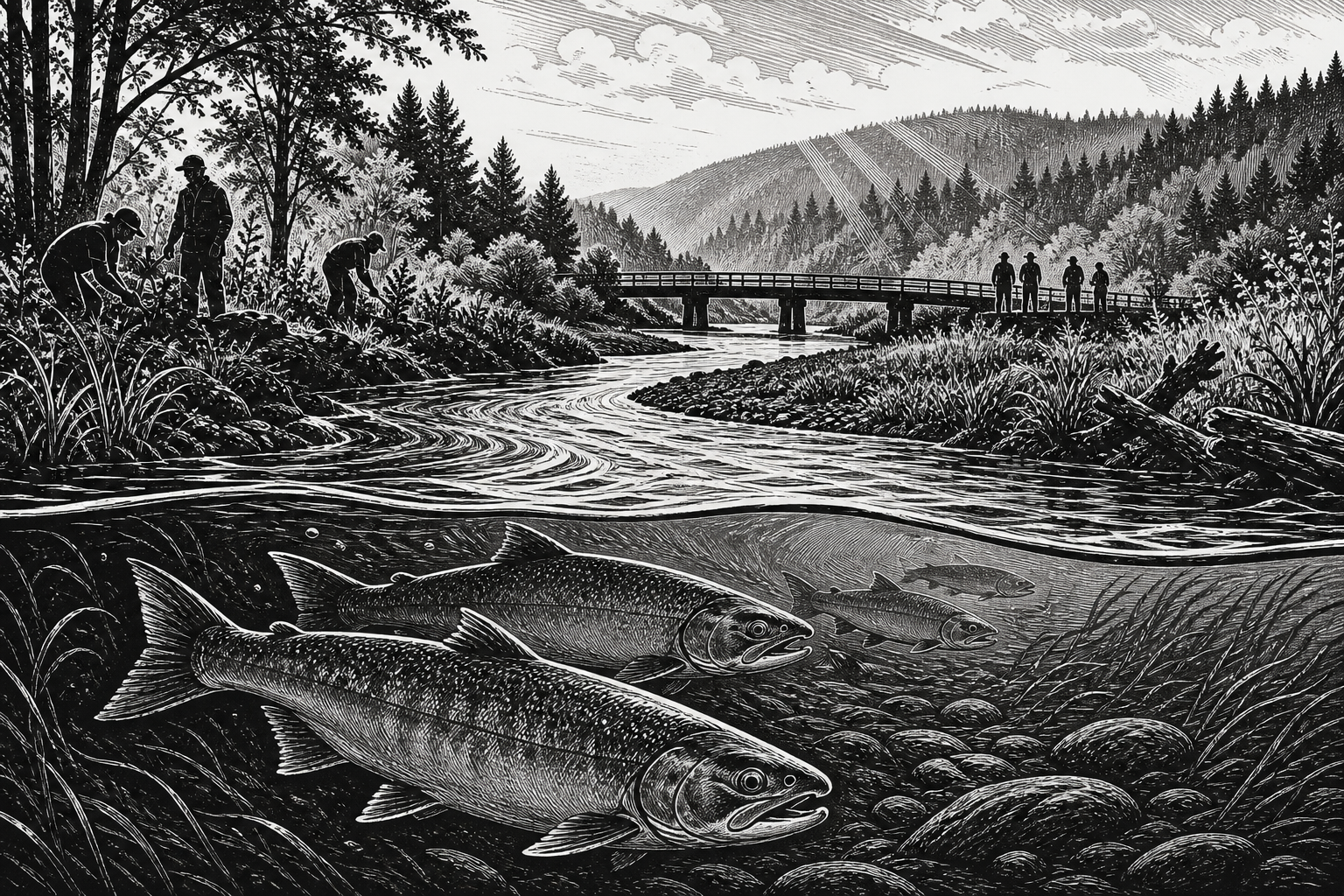
On Washington’s Olympic Peninsula, crews are finishing a river restoration project designed to solve two problems that have too often been treated separately: threatened salmon need a healthier river, and people living downstream need floodwater to move with less force.
Giving the river room again
NOAA Fisheries awarded $9.7 million to the Hood Canal Salmon Enhancement Group to rebuild part of the Big Quilcene River in Moon Valley. Instead of keeping the water inside one artificially straightened channel, the project creates a 1.84-mile braided network and reconnects the river to 140 acres of floodplain.
More than 180 engineered log jams and new spawning-size gravel will add the varied currents, shelter, and riverbed conditions salmon use at different stages of life. NOAA says the redesigned system is also expected to cut downstream flood velocity in half and reduce the severe erosion that has pushed sediment toward the channel and estuary.
A rebound worth understanding carefully
Preliminary Hood Canal Coordinating Council data offer a hopeful backdrop. Average annual returns of threatened Hood Canal summer-run chum rose from about 11,600 fish between 2018 and 2021 to roughly 32,600 between 2022 and 2025. In the early 1990s, fewer than 1,000 spawners returned.
That increase should not be credited to one construction project. NOAA notes that several years of favorable ocean conditions helped salmon survive at sea, while the coordinating council points to decades of harvest management, habitat protection, restoration, and improved scientific understanding. The new river work is an investment in making those gains more resilient, not a victory lap.
Community goals in the same channel
The larger Lower Big Quilcene effort has been shaped by county agencies, restoration groups, tribes, landowners, and residents. Public project records name six connected goals: habitat, shellfish compatibility, recreation, education, flood-risk reduction, and economic opportunity. That list matters because it describes restoration as community infrastructure rather than scenery.
A healthier floodplain can slow water, hold habitat, and reduce pressure downstream. Salmon recovery still depends on ocean conditions and sustained regional work, and flood safety still requires careful monitoring. But the project demonstrates a practical form of hope: redesigning a river so that more living things, including people, have room to weather what comes next.